
THOUSAND OAKS
AGOURA HILLS
BURBANK
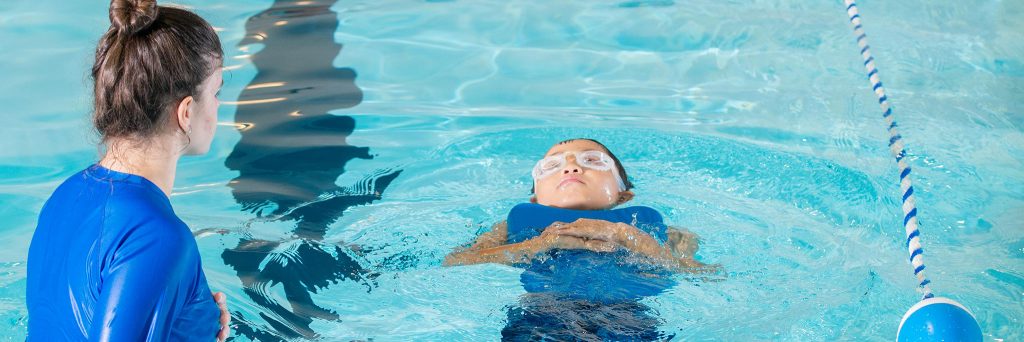
It is impossible to determine how long a child will take to learn to swim. Many factors affect the learning process such as age, physical development of the child, playtime in the pool, frequency of lessons, and parental style/approach to swimming. Many two year-olds can swim around the pool breathing independently after 2-3 months with two lessons per week.
We recommend that children be exposed to swimming in a Baby and Me class as early as 6 months of age. This is particularly important for the child who is around a pool or body of water. Formal swim lessons can start as soon as the child can walk confidently. Swimming lessons prior to age four significantly reduces the chance of drowning. (American Medical Association Archives of Pediatric Medicine 2009).
Children under three (and older if not fully potty-trained) must wear a disposable swim diaper AND a plastic-lined swimsuit/diaper. The plastic-lined diaper is provided with the registration fee. Girls or boys with hair that is long enough to impede breathing or drip excessively in the face must wear a bathing cap. Don’t forget a big fluffy towel (or two).
We discourage goggles during the learning process so children don’t get used to them. Remember, when children accidentally fall in a pool they are very seldom wearing goggles. Goggles can be used once a child can swim confidently.
Our teachers are trained to work with even the most fearful or nervous swimmers. Reassure your child and stay calm and then let the instructor work with your child. Some children experience separation anxiety or fear of a new place which both will diminish with time. This is especially prevalent in children ages 1 ½ to 3 years of age.
Fear of the water is common with older children. Over the years we have developed many strategies to work through and overcome a student’s fears and anxiety. We recommend that you do not pull your child out of the pool during a lesson or stop lessons altogether. This can be detrimental because it allows the fear to be reinforced without giving the lessons a chance to work and the instructor the opportunity to alleviate the student’s fears. Your child’s safety is our top priority. Please be patient and allow the instructors and staff to do what we do best – teaching every child to learn to swim and love to swim!
It depends upon the level of illness. However, if your child is showing flu-like symptoms, has a fever, or any stomach or digestion problems, we request that they do not attend swim lessons. [Especially during COVID19]
Yes. To receive a make-up lesson for your missed class, you must cancel your regularly scheduled lesson in advance. Your make-up lessons can not be used as credit, but they can always be used anytime you are enrolled in a class. Make-up lessons can only be scheduled three days in advance. Make-ups are not available for “no show” lessons or swim team.
Our lap pool is kept between 86 and 88 and our teaching pool is 90 degrees. By keeping the temperature warm, the child does not have to “get used to” the water, but can begin learning right away.
You can enroll online anytime and start right away pending availability! You will be asked to enter a credit card in our secure online Parent Portal. Tuition is paid at the time of enrollment. Our office is open seven days-a-week, so come by and find an available lesson time that is convenient for you.
For learn-to-swim students, expect to commit to lessons for two months. For once per week students, that is approximately eight lessons. We believe that it is important to commit to the process and allow time for the Daland teaching progression to work.
Kickstart is a great option to get your swimmer going faster. Most Kickstart lessons are 8 lessons, Monday through Thursday for two consecutive weeks. Sometimes we offer a one-week 5 lesson Kickstart session, Monday through Friday. This is also a great option for families who are prepping kids for a summer vacation, or who just want to swim in the summer.
Just give us a call. We will do our best to find a time or day that is a better fit for you.
At Daland Swim School we believe that there is no such thing as “drown-proofed” or “water safe.” We teach students swimming skills and love and respect for the water. No one is ever completely water safe. Close, attentive supervision by an adult who knows how to swim (and perhaps CPR as well) is always recommended when children are in the water.
Leslie Daland is a Board Member for Stop Drowning Now, a non-profit dedicated to Water Safety Education in the classroom. In our lessons, we teach water safety rules along with swimming skills. Follow the Safer-3 for drowning prevention. 1. Safer kids: give them swim lessons. 2. Safer water: fence your pool, lock your gate. 3. Safer response: know what to do in an emergency, learn CPR.
Yes! Our instructors have additional training specifically for children with Special Needs.
Often, children with special needs exhibit an incredible joy while swimming and it can be instrumental in their development. If your child has special needs, please communicate with the office staff and the instructor about their individual needs. The more information the instructor has, the more effectively the swim lesson will be.
The bathtub is a great place to enjoy water play and to help a child become more comfortable with the water. Many skills can be practiced in a bathtub. Don’t be afraid to pour water over your child’s head and face. We also encourage the parent to take their child in a pool as often as possible. Exposure to swimming and having fun in the pool is the best way to mitigate or eliminate any fear of water or swimming.
Absolutely. We believe that all adults should know how to swim comfortably across the pool. It is particularly important for parents, to help ensure the safety of their children. We have a special curriculum for non-swimming adults – addressing the fears and different relationships with the water.
To qualify for the team and be placed on the appropriate squad, all swimmers (ages 5-18) must do a TRYOUT (swim 25 yards of each stroke (butterfly, backstroke, breaststroke and freestyle.)
Our Pre-Team group is a great opportunity for swimmers who are not quite ready for team. This group consists of swimmers who can swim 25 yards of freestyle and backstroke, but are still working on the details of butterfly and breaststroke.
No. Competition is not mandatory, but is encouraged. Competition helps children learn goal setting, sportsmanship, and pride in individual achievement. We would like our athletes to move gradually toward their full potential, in a fun and supportive environment. Swim meets are held once a month (or so) with championship meets every year. SWIM MEETS
Our coaches continually emphasize technique and utilize specific stroke drills to help your child improve his competitive strokes during practice.
We do not require parents to volunteer or fundraise. Parents may be asked to help time at swim meets.
Practice are held on weekday afternoons and Saturday mornings. We offer flexible scheduling (once per week or multiple days per week). To avoid overcrowding we ask you to pick the days that you will be attending.
If swimming is your child’s primary sport or physical activity, we recommend that she swims more than once a week for improvement and health. If your child also plays another sport, he should swim once a week to maintain his swimming skills.
We offer a high school conditioning squad in the mornings before school. This is a great option for your child to improve her conditioning and swimming skills in preparation for high school season.
You can drop your child off, or you may stay and watch practice. Please do not drop your child off more than 15 minutes prior to the start of practice.
Our more advanced squads do dryland training before practice to strengthen the core, improve overall conditioning, and reduce injury.
We have a very low swimmer to coach ratio, and a strong emphasis on proper stroke technique. Often, we have one coach in the water to correct the swimmer’s form. Since Daland owns the facility, you can rely on consistency of practice time and location.
All swimmers need a competition-style suit, a team cap, goggles, and fins. Different squads (e.g., white, yellow, senior) have different equipment requirements.